Bio:
I am a current Master of Community Planning student at Auburn University from Birmingham, Alabama. Previously I have received a bachelors degree majoring in Political Science with a minor in Geographic Information Systems from the University of Alabama. I also have two years of experience working at the Baldwin County Planning and Zoning Department. My work included code enforcement, environmental reviews, site plan approvals, along with rezonings, variances, commercial developments, and administrative appeals before the Board of Adjustment and Planning Commission.
My education provided a strong foundation for working at one of the fastest growing metropolitan statistical areas in the country which allowed ample and diverse opportunities to experience many sides of the municipal planning process.

Career Objectives/Professional Goals:
I am looking to re-enter the field of urban planning, preferably in a municipal setting. Having a positive impact on the development of a community though public service remains my top career objective. I hope to eventually become a planning director and perhaps move into city management.
I have a passion and fascination with city planning and feel obligated to continue to pursue success the field both for myself and for the citizens I may serve. I hope to continue to diversify my experience and gain exposure to as much of the field as I can, both at at the office and through professional development. I am hoping to pursue my AICP and CNU-A certifications in accordance with these principles.
Public Service Philosophy:
I view city planning as a public trust grounded in service, fairness, and respect for individual rights and community values. My philosophy is to promote balanced growth that sustains both economic opportunity and environmental integrity, ensuring progress never comes at the expense of equity or quality of life.
I believe in transparent, accessible planning processes that empower citizens to have a meaningful voice in shaping the places they call home. By fostering open communication, listening to diverse perspectives, and upholding civic liberties, I strive to guide development that reflects collective priorities while safeguarding the rights of all residents.
“Intricate minglings of different uses in cities are not a form of chaos. On the contrary, they represent a complex and highly developed form of order.”
“The city is a fact in nature, like a cave, a run of mackerel or an ant-heap. But it is also a conscious work of art, and it holds within its communal framework many simpler and more personal forms of art. ”
“No house should ever be on a hill or on anything. It should be of the hill. Belonging to it. Hill and house should live together, each the happier for the other.”


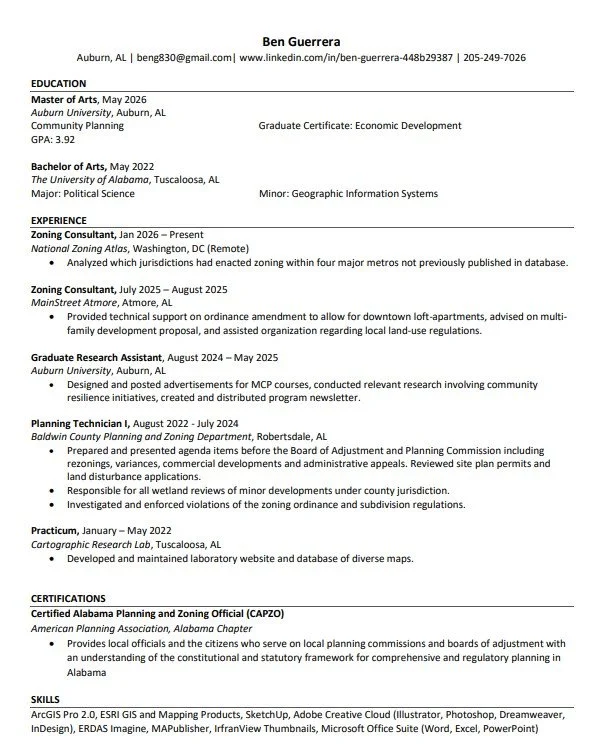
SLO 1: As part of my coursework this semester, I am taking Local Economic Development to further sharpen my economic development knowledgebase. Most of our readings and writing assignments involve the book Planning Local Economic Development: Theory and Practice by Nancy Green Leigh and Edward J. Blakley. My first paper revolves around the first few introductory chapters of the book. Topics include an overview of the major concepts and components that define local economic development and the different development theories that economic developers subscribe to.
This assignment was extremely informative for me as a city planner. It is imperative that I understand not just the negative side of dealing with incoming developments, but also the reverse side of that coin. What conditions need to be in place in order for development to happen in the first place? It is not enough to be reactive, just calling balls and strikes as we see them. Good planning is proactive and sets the table for the kind of cities that communities want instead of retroactively trying to mold incoming investment into the form we would like it to take. Not just that, an important metric is that 80% of job creation is done by existing businesses. In the field of economic development often too much attention is placed on getting that new investment because it generates so much positive publicity. But in terms of just raw numbers of jobs, enough attention must be placed on supportive the existing businesses in order to shore up and grow the current base of jobs.
SLO 2/3: As part of my coursework in the Urban Economics class I took, we studied the work of Alain Bertaud in his book Order without Design: How Markets Shape Cities. He focuses on the relationship between city regulations and market dynamics and how the clash of these two forces. I wrote a paper as part of a group project where I contributed the final portion about Chapter 7 and 8 of the book. These sections focus on collaboration between urban planners and economists, as well as a critique of urban planning policies and their effects on development.
There are few areas of policy that impact local economics more than planning. This impact can be measured especially in the field of real estate development, which in a way is the bedrock of the wider economic landscape. Chapter 7 brings up the obvious but often overlooked fact that there are almost no trained economists who are planners. They typically have very little economic training and few interactions and overlap with economists. It is important for me to keep this potential blind spot in in mind in order to properly critique and guide land use policy in my field. Chapter 8 of the book focuses on the idea that regulatory schemes, however lovingly conceived, often have very different or even the reverse effect that was originally intended. Along with that, the need to reform outdated codes is just as important as the need to add new ones. Ordinances and regulations can become burdensome and outdated if not regularly reformed, both in the sense of their addition and subtraction.
SLO 4: I took an economic development course in the summer of 2025 where we worked directly with the economic development agency in Conecuh County Alabama. This was great hands-on experience where I got to move from the theoretical to the practical. As part of my ‘Understanding a Local Economy’ assignment, I got to pull real census data on the community and draw insights as to the challenges and opportunities in facing the county.
This assignment showed me the importance of data in the field of economic development. In order to formulate a strategy to entice development, you have to know your own community and its relevant datapoints. Things like population, incomes, education, age ranges, and much more are the bedrock knowledge needed in order to begin the work of a local economic developer. By taking this data, and comparing it with state and national level information, only then you can determine what stands out. Which areas are the strengths and weaknesses of the locality? How then does that influence what is possible and what is feasible? It is the all important first step and this assignment gave me hands on experience doing it.
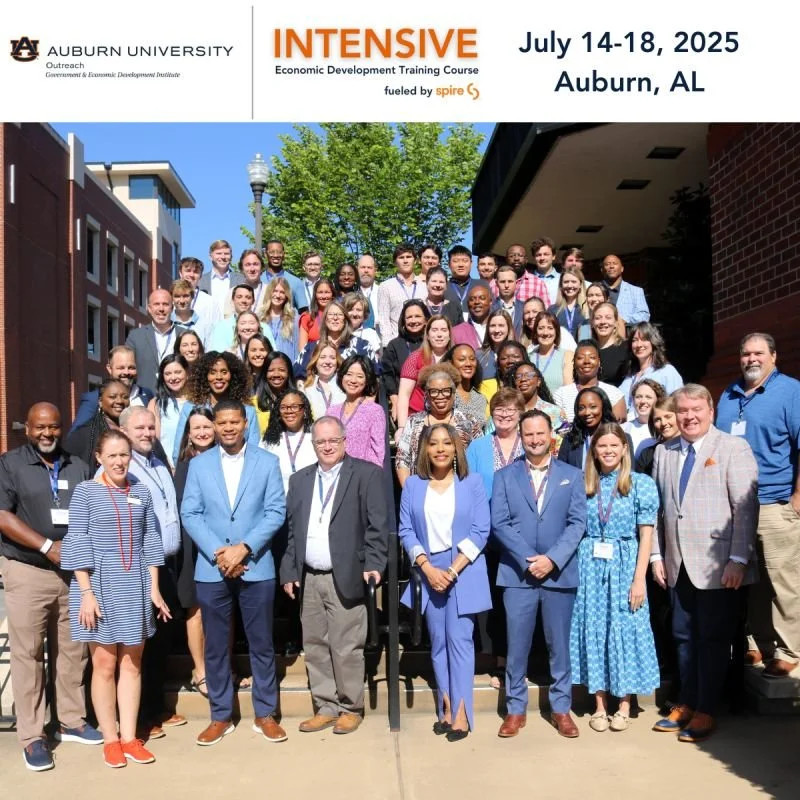
SLO 5: In the summer of 2025 I attended the Intensive Economic Development Training Course by the Government and Economic Development Institute at Auburn University. I had the opportunity to meet leaders and other students from across the state and hear talks from local officials and entrepreneurs. It was a crash course in economic development and I gained many insights into the field and the latest trends shaping it. There were many speakers who brought their direct experience in economic development to light as well as hands on activities. The week culminated in a final presentation. GEDI staff divided up the conference into three teams..
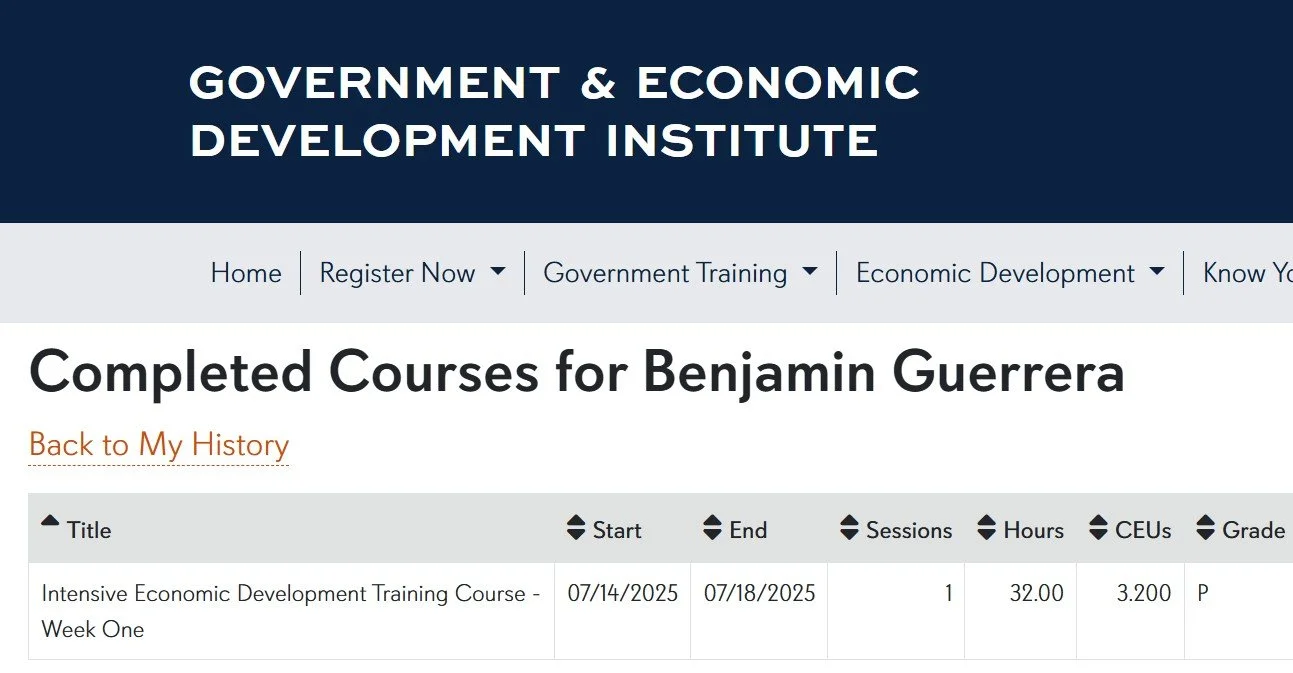
P grade indicates I passed the requirements of the Intensive Economic Development Training Course!